
The Chessmen: Major & Minor Pieces
Understanding the distinct roles of Major and Minor pieces is fundamental to chess strategy. While Queens and Rooks (Major Pieces) dominate open lines and endgames, Bishops and Knights (Minor Pieces) excel in early tactical skirmishes and maneuvering. This guide breaks down exactly how each piece moves and captures.
In chess, pieces are often categorized by their strength. You have the powerful Major Pieces (Queen and Rook) and the lighter Minor Pieces (Bishop and Knight).
In this guide, you’ll learn exactly how they move and capture.
The Rook
The rook is a long-range powerhouse that forms the backbone of heavy piece attacks and endgame strategy.
The Rook is a Major Piece (Value: 5 Points).
It is considered a "heavy" piece because a single Rook and King can force a checkmate against a lone enemy King.
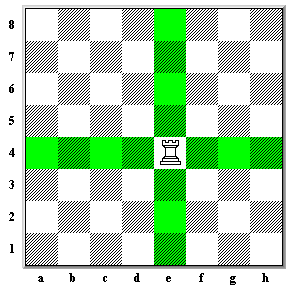
The rook moves horizontally and vertically any number of squares, forwards or backwards. In the diagram below the rook can move to any of the highlighted squares.
However, other pieces can restrict its movement. In the diagram below, the rook can now only move to the highlighted squares.
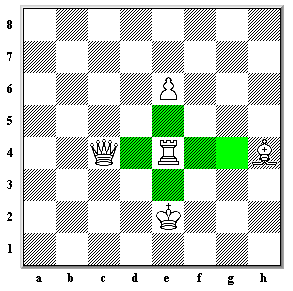
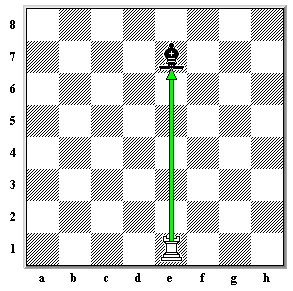
In the diagram above, the pieces blocking the rook are from the same army. If an enemy piece is standing in the way of the rook, it may be captured. In the diagram below the Black bishop is blocking the path of the rook. The rook is unable to travel past the square on which the bishop is standing but the rook can claim the bishop's square for itself! This is done by capturing the bishop.
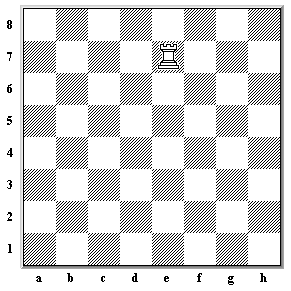
The capture is carried out by removing the bishop from the board and replacing it with the rook. In the diagram below, the rook has captured the bishop. Notice how the rook has not jumped over the bishop but has claimed the square for itself. All the chessmen capture in this way.
The Bishop
The Bishop is a Minor Piece (Value: 3 Points).
It is lighter and faster to develop, but cannot checkmate a lone King by itself.
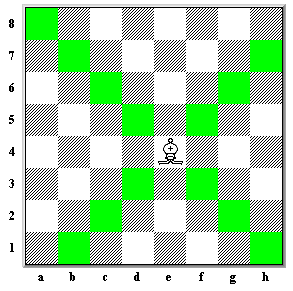
The bishop moves diagonally any number of squares, forwards or backwards as long as its path is not blocked by other pieces. The diagram below shows all the possible squares to which the bishop may move. Each side has two bishops; one bishop moves along the light coloured squares and the other bishop moves along the dark coloured squares.
The Queen
The Queen is the most powerful Major Piece (Value: 9 Points).
She combines the powers of both the Rook and the Bishop.
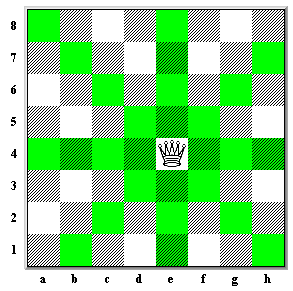
The queen is the most powerful piece on the board. This is because it can control more squares than any other chessman. It moves straight forward, backwards or diagonally any number of squares as long as its path is not blocked by other pieces. In the diagram the queen can move to any of the highlighted squares.
The Knight
The Knight is a Minor Piece (Value: 3 Points).
It is unique because it is the only piece that can jump over others!
The knight moves in an L shape in any direction. FIDE Master, Graham Burgess (in The Mammoth Book of Chess) describes how his father, when helping him to visualise how the knight moves, told him to think of a "six" as displayed on a die or domino. The dots are displayed as either:


The knight moves from one corner to the furthest corner from it. The knight in the following diagrams could move to the square marked with a cross:


The knight changes the colour of the square it stands on with each move. Therefore, if it starts off on a light coloured square, when it has finished its move it will land on a dark coloured square.
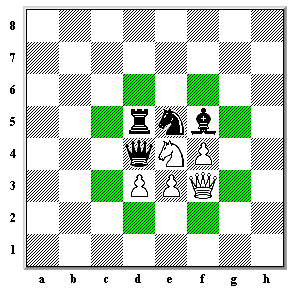
The knight is the only piece whose journey is not impeded by other pieces on the board. If its destination square is vacant, it may jump over pieces in its way. Therefore, the white knight can move to any of the highlighted squares in the diagram below.
The King
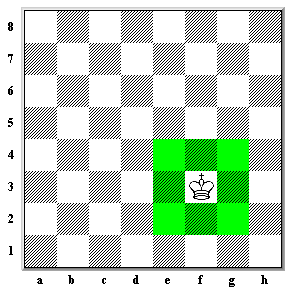
The king is the most important piece on the chessboard. It can never be captured and if it is not possible to make the king safe then the game is lost. The king may move one square in any direction. In the diagram the king is able to move to one of the highlighted squares.
However, the king is the only piece that must never move on to a square that is being attacked by his opponent's pieces. In the diagram the king cannot move onto the squares marked with a cross because the black bishop is attacking those squares.
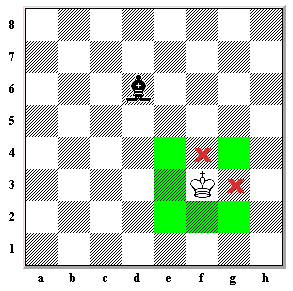
If an enemy piece is on a square that the king can move to, the king may capture that piece. In the diagram the king may capture the rook.
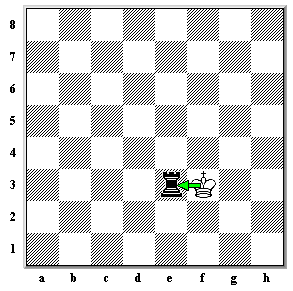
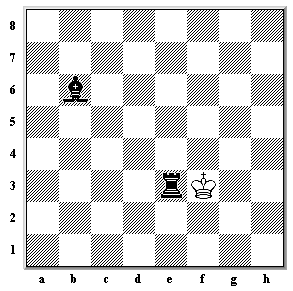
The position shown in the diagram below is almost the same as in the diagram above. However, there is one very important difference. The bishop is now protecting the rook so that if the king captured the rook the king would be attacked by the bishop. The king can never move himself into danger like this so he is unable to capture the rook.
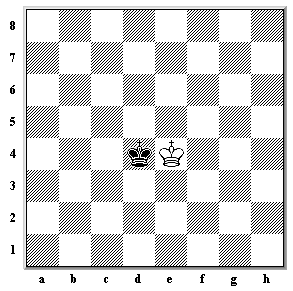
Consequently, because the king must never move on to a square that is being attacked by enemy pieces, two kings can never stand next to each other on the chessboard. The position in the diagram below is illegal.
FAQ
What is the difference between a Major and Minor piece?
A Major Piece (Rook or Queen) can help the King deliver checkmate against a lone enemy King. A Minor Piece (Knight or Bishop) generally cannot force checkmate on its own.
How does the rook move?
The rook moves horizontally and vertically any number of squares, forwards or backwards, until it is blocked.
Can the bishop move backwards?
Yes. The bishop moves diagonally any number of squares forwards or backwards, as long as the path is not blocked.
➡️ Next Steps
Next up: what “check” and “checkmate” mean — and how a game actually ends.