

In this article:
Improving results! - Being able to finish off the opponent!
Positional play can bring excellent positions. It can be used to put the opponent under enormous pressure, reduce their counterplay, and generally put the opponent on the rack!
However, to finish off the game usually requires a tactical blow which will convert the advantage in a technical way. The name given to a series of tactical moves which may involve a sacrifice is a combination.
For example, if one has a passed pawn, there may be a tactical combination to forcefully queen it. If the opponent's king safety is suspect, there may be a combination to checkmate. Tactical ability and the ability to spot combinations thus help to convert positional advantages into more concrete gains.
Tactical awareness in implementing positional plans
Even strongly positional players should be aware of the tactical resources hidden in the position. Even if combinations are not played, it is very important to have tactical awareness when trying to carry out positional plans. Positional plans can fail tactically even though their concept is very good.
There are positional players (even at club level) who know how to put their opponent under significant pressure. If they improved their tactical awareness while sticking to their fundamental plans, they would be even more effective. They would not:
- Fall for simple tactical traps set by their opponent.
- Beat around the bush excessively with positional play when there is a clean tactical kill available.
It is not enough to judge positions based on superficial appearances. Tactical variations provide reassuring evidence for one side being better or worse.
"Test your positional play" by Bellin and Ponzetti is an excellent book that incorporates an analysis of tactical variations to validate the selection of appropriate positional plans. This highlights that practical problems associated with implementing a plan are often tactical in nature.
Being able to survive in tactical situations!
Positions can be broadly categorised as "open" (full of open lines and piece play) or "closed" (blocked and maneuvering). In open positions, tactics can dominate completely, and the value of formulating long-term positional plans is diminished because it is vital simply to calculate the necessary variations to stay alive!
A positional player might argue that they play solid openings to avoid complications. However, what if the opponent forces the game into tactical waters by playing gambits? The positional player needs to be tactically aware even if they attempt to build a safe infrastructure.
A results-focused path for the developing player
A chess player should generally learn tactics before deep positional play, because winning at the club level is usually the result of tactics rather than subtle positional squeezes. In snooker, the analogy would be learning to pot balls before learning complex safety play.
The more abstract elements of chess should be introduced after the player is familiar with the basic arsenal of tactics. Winning games tactically provides a solid foundation for understanding why positional play (accumulating small advantages) is necessary when tactics aren't immediately available.
Dramatic Example
Most beginners would enjoy mating their opponent and gaining a victory with the following sequence:
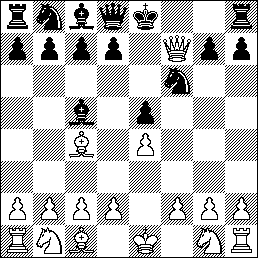
1.e4 e5 2.Bc4 Bc5 3.Qh5 Nf6 4.Qxf7#
There are many implications of playing this game as a newcomer to chess:
- Chess games can produce results quickly!
- Pieces can coordinate—in this example, the Bishop and Queen have successfully combined.
- The opponent's King is a vulnerable piece!
Even though this game violates some opening principles (bringing the Queen out early), it teaches valuable lessons about piece activity and weaknesses. Combinative ability:
- Improves results immediately.
- Provides satisfaction in the beauty of chess.
- Teaches about direct piece play.
- Ensures that positional play learnt later is purposeful—aimed at creating these tactical opportunities.